
How to Start a Community Card Business in 2026
Learn how to start a community card business — the 6x11 postcard with 16 ad slots at $250 each. Step-by-step guide to $2,600 profit per card with zero upfront cost.
Here's the thing. Everybody wants to start a community card business but they freeze up because the full 9x12 card feels too big, too expensive, or too scary to sell. I get it. Asking a local business for $500 when you've never done this before? That's a real mental hurdle. So let me show you the on-ramp — the smaller, faster, lower-risk cousin that gets you your first win in two weeks instead of thirty days.
The community card. It's the easiest entry point in this entire business, and honestly, it's where I'd tell every single beginner to start right now.
What exactly is a community card?
A community card is a 6"x11" postcard — smaller than the full 9x12, but still big enough to stand out in a mailbox. It has about 16 coupon-style ad slots on it, each one sold to a local business for $250. You collect all the money, send it to print, and it gets mailed to 2,500 homes in a specific neighborhood via USPS EDDM.
That's the whole thing. Simple but not easy.
Each slot is a little coupon-style box — the business name, a quick offer, maybe a phone number or QR code. Think of it like a "Community Spotlight" card where every local business gets a spot to advertise to their neighbors. The design is templated, so you're not reinventing the wheel every time.
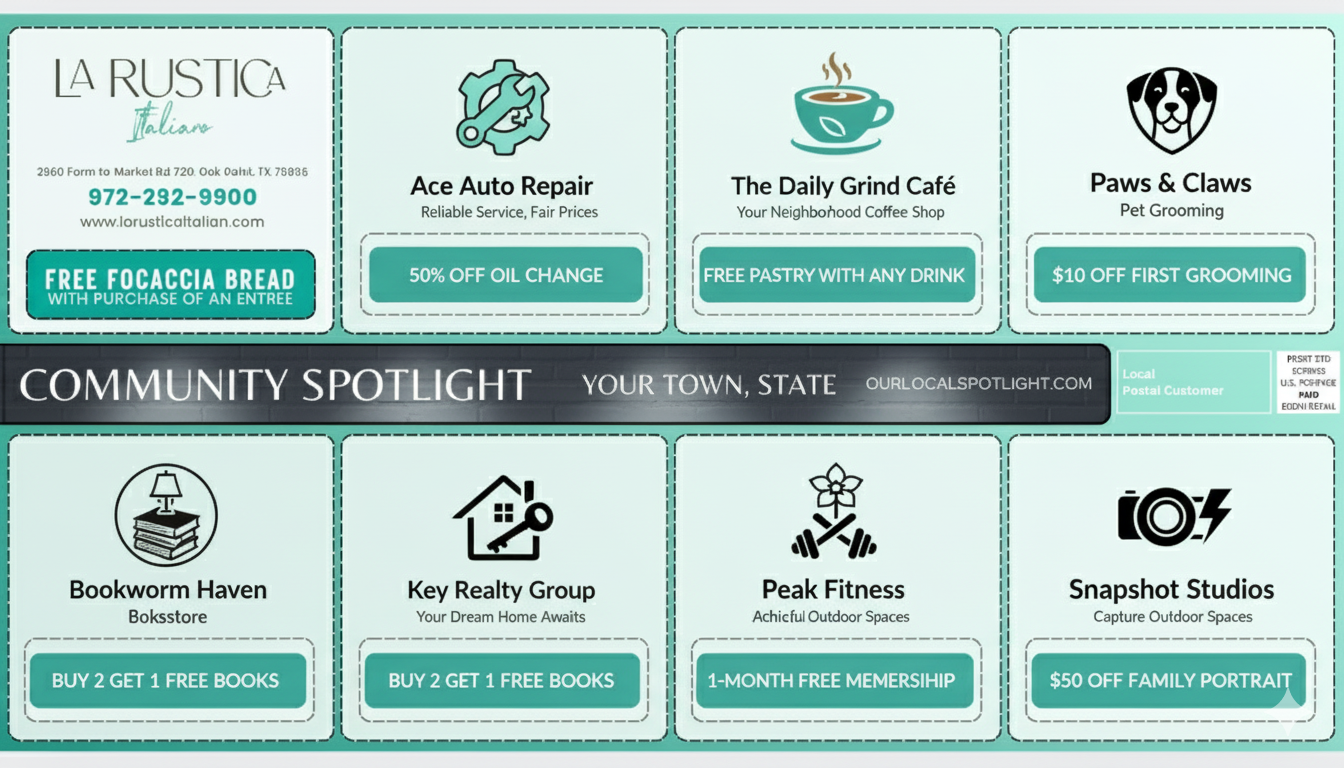
This is what one actually looks like. Sixteen local businesses, coupon-style offers, one card, 2,500 mailboxes. Every slot is a paying advertiser who said yes to $250. Nothing complicated about it.
The beauty of this is that $250 is a no-brainer for most small businesses. You're not asking them to take a risk — you're asking them to skip one dinner out and reach 2,500 homes instead.
The numbers — community card economics
Okay so let me break down the actual math. Because this is a numbers game and the numbers on the community card are really, really clean.
Read that last line again. Zero dollars upfront. You collect all the money from your advertisers before you ever pay for printing. That's not a gimmick — that's how the model works. You're essentially pre-selling every slot, then using that revenue to cover your costs. The $1,400 for print and fulfillment goes through print.9x12method.com, which handles everything — printing, packaging, and dropping at USPS for EDDM delivery.
So you collect $4,000. You spend $1,400. You keep $2,600. And the whole thing takes about two weeks from start to mailboxes.
Community card vs 9x12 — side-by-side comparison
Look. I'm not going to pretend the community card is "better" than the full 9x12. They're different tools for different situations. Here's the honest comparison:
| Metric | Community Card | 9x12 Card |
|---|---|---|
| Card size | 6" x 11" | 9" x 12" |
| Slots | ~16 | ~16 |
| Price per slot | $250 | $500 |
| Revenue | $4,000 | $8,000 |
| Print + fulfillment | $1,400 | $2,900 |
| Profit | $2,600 | $5,100 |
| Homes mailed | 2,500 | 5,000 |
| Fill time | ~2 weeks | ~30 days |
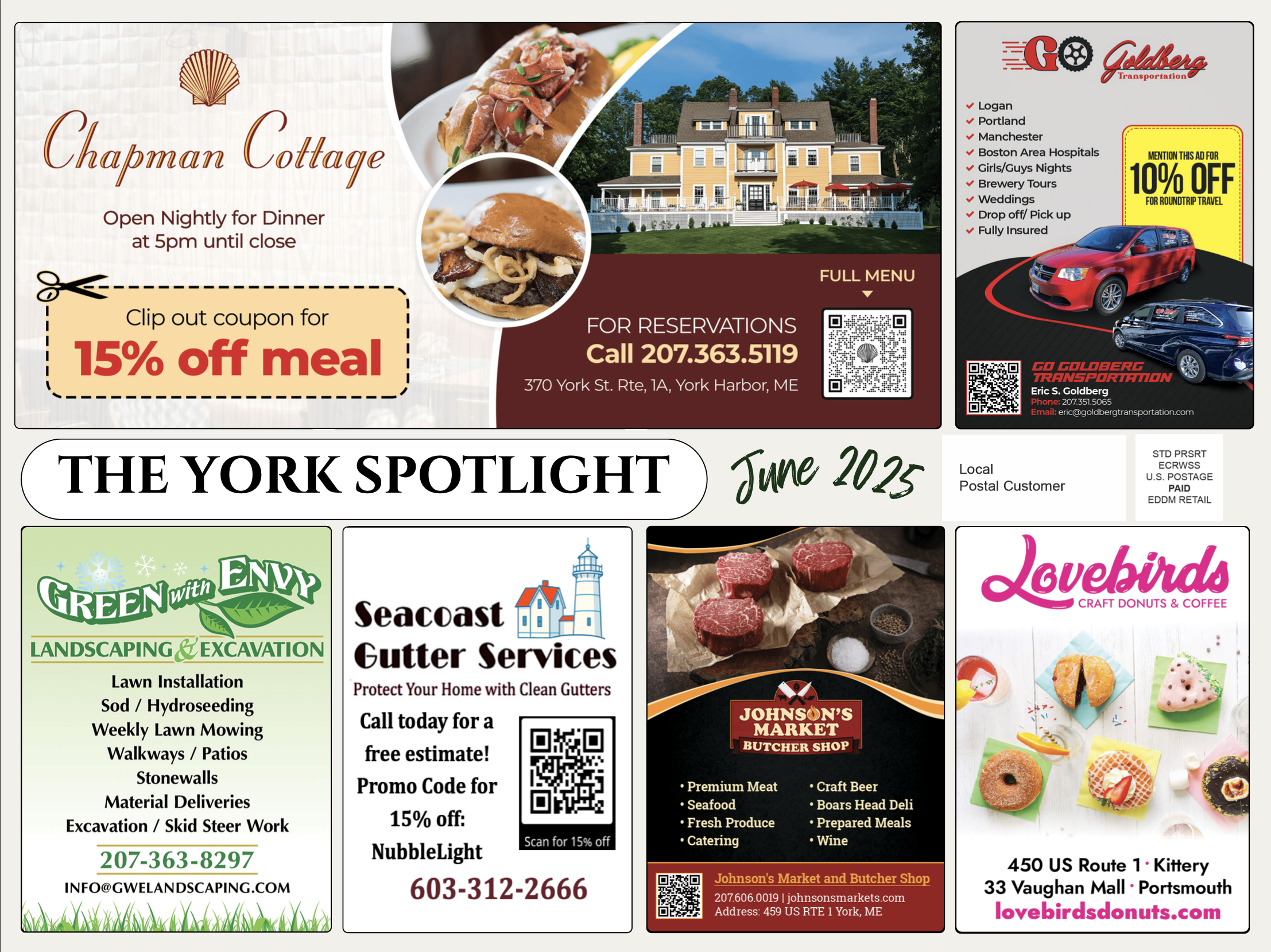
The 9x12 is the bigger card — literally almost three times the size of a standard mailer. It reaches twice as many homes and makes almost double the profit. But it also takes twice as long to fill and the $500 price point is harder to close when you're brand new.
Here's why the community card matters: it's the training ground. You learn the pitch, you learn the fulfillment process, you build relationships with local businesses, and you put money in your pocket — all in two weeks. Then when you're ready, you graduate to 9x12 cards with confidence and a pipeline of businesses who already trust you.
How to sell and fill a community card (step by step)
This is the actual playbook. Follow it and you'll have a filled community card in about 14 days.
-
Step 1: Pick your area. Choose a neighborhood with 2,500 homes. Look for areas with a strong mix of local businesses nearby — strip malls, downtown districts, suburban shopping centers. Use USPS EDDM route selection to map it out.
-
Step 2: Build your prospect list. You need about 30-40 local businesses on your list to fill 16 slots. Not every business will say yes, so you need more prospects than slots. Use Lead Scout or just Google Maps. Restaurants, salons, dentists, landscapers — anyone who serves the neighborhood.
-
Step 3: Start outreach. Facebook Groups are the number-one channel. Find local business groups and community groups in your area. Post something like: "Hey, I'm putting together a Community Spotlight card for [neighborhood name] — 2,500 homes, 16 local businesses featured. Spots are $250. Anyone interested?" You can also cold email, cold call, or walk in door-to-door.
-
Step 4: Show, don't tell. When a business owner is interested, show them a sample card. The image above? Use something like that. When they can see what their coupon will look like sitting in someone's mailbox, the $250 price becomes obvious. Don't quote the price before showing the card.
-
Step 5: Collect payment and ad info. Once they say yes, collect payment upfront (Venmo, Zelle, check, invoice — whatever works). Get their business name, offer/coupon text, logo, and contact info. Use the 9x12 Method CRM to track everything.
-
Step 6: Design and submit for print. Once all 16 slots are filled (or close to it), finalize the design using the community card template. Submit to print.9x12method.com for the $1,400 flat-rate print and fulfillment. They print it, package it, and drop it at USPS.
-
Step 7: Notify your advertisers. Let every business know when the card is dropping. Send them a photo of the printed card. This builds trust and sets you up for renewals next month.
Best industries for community cards
Not every business is a great fit for the community card. The sweet spot is lower-ticket local businesses that serve the neighborhood directly. These are businesses that might hesitate at $500 for a 9x12 slot but jump at $250 to reach 2,500 homes.
Here are the industries that crush it on community cards:
- Restaurants and cafes — Everyone eats. A "10% off your first order" coupon from the Italian place down the street? That's getting used.
- Coffee shops — "Free pastry with any large coffee." Done.
- Pet groomers — Every neighborhood has dog owners. Lots of them.
- Salons and barbershops — "$15 off your first haircut" is a classic coupon play.
- Dentists and chiropractors — "Free exam for new patients." They're always looking for new patients in the area.
- Landscapers — Seasonal. Spring and fall are gold. "10% off spring cleanup."
- Painters — Same seasonal play. They need leads constantly.
- HVAC companies — "AC tune-up for $79" before summer. Sells itself.
- Roofers — After any storm season, this is a no-brainer.
- Fitness studios and gyms — "First week free" or "No enrollment fee this month."
The community card 9x12 connection is real here — many of these same businesses will eventually upgrade to the full 9x12 card once they see results from the community card. You're building your pipeline while getting paid.
The pitch that works at $250
Here's the thing about selling a $250 ad slot. It almost sells itself.
Think about it from the business owner's perspective. They spend $250 on a boosted Facebook post and it reaches maybe 800 people who scroll past it in 0.3 seconds. Or they spend $250 on a community card slot and their coupon lands physically in 2,500 mailboxes — sitting on kitchen counters, pinned to fridges, handed to spouses.
The pitch is dead simple:
"Hey [name], I'm putting together a Community Spotlight card for [neighborhood]. It's a postcard that goes to 2,500 homes with coupon-style ads from about 16 local businesses. Each spot is $250. Your coupon would be right there next to other trusted local spots. Would you want a slot?"
That's it. It is that simple.
You're not asking for a huge commitment. You're not asking them to sign a contract. You're asking them to split the cost of a postcard with 15 other businesses so everybody reaches 2,500 homes for practically nothing.
Most business owners spend more than $250 on a single lunch meeting. When you frame it that way, it clicks fast.
Scaling with community cards — the real math
Here's where it gets interesting. One community card is great — $2,600 profit, nice little win. But this is a volume game. Let me show you what happens when you start stacking them.
| Metric | 1 card/month | 3 cards/month | 5 cards/month |
|---|---|---|---|
| Revenue | $4,000 | $12,000 | $20,000 |
| Print costs | $1,400 | $4,200 | $7,000 |
| Profit | $2,600 | $7,800 | $13,000 |
| Homes reached | 2,500 | 7,500 | 12,500 |
Three to five community cards per month puts you at $7,800 to $13,000 in profit. Monthly. With zero upfront capital and a two-week turnaround per card.
Full transparency — I do teach all of this inside the community, where 2,800+ operators are running this exact playbook. You absolutely don't need the community to do this. Everything I just told you is the whole strategy. But if you want scripts, templates, live coaching calls, and a group of people doing the same thing — that's what it's there for. No pressure either way.
The scaling math is also why a lot of operators do a mix — community cards for quick wins and pipeline building, plus 9x12 cards for bigger profits. You might run three community cards and one 9x12 in the same month. That's $7,800 + $5,100 = $12,900 from four cards. And every community card advertiser is a warm lead for a future 9x12 slot.
The small postcard marketing game isn't about picking one format and riding it forever. It's about using the right tool for the right situation. Community cards are faster. 9x12 cards are more profitable. Smart operators use both.
When to graduate to 9x12 cards
So when do you move up? There's no hard rule, but here's my honest take.
You're ready for the 9x12 when:
- You've filled 2-3 community cards successfully — You know the process. You know how to pitch. You know how to manage advertisers.
- You have repeat advertisers — If businesses are coming back for a second or third community card, they trust you. That trust makes the $500 conversation way easier.
- You're comfortable with the sales process — The pitch at $500 is the same pitch at $250, just with bigger numbers. If $250 feels easy now, $500 will feel manageable.
- You want bigger profits — $5,100 per card versus $2,600. Almost double. At some point the math speaks for itself.
- You have a pipeline — You know enough businesses in your area that filling 16 slots at $500 doesn't feel impossible.
Here's what I'd actually recommend: don't stop doing community cards when you add 9x12. Keep running community cards for new neighborhoods or for industries that fit the $250 price point better. The 6x11 postcard business and the 9x12 business aren't competitors — they're complements.
And honestly, some operators never move to 9x12 at all. They run five community cards a month, make $13,000, and they're perfectly happy. That's a real business. Don't let anyone tell you the community card is just a "stepping stone." For a lot of people, it's the whole thing.
Common mistakes to avoid
I've seen a lot of people start this and trip over the same stuff. Let me save you the trouble.
Waiting too long to start outreach. You don't need the perfect prospect list. You don't need the perfect script. You need to talk to 5 business owners this week. That's it.
Trying to fill all 16 slots before collecting any money. Collect as you go. Get 4 slots sold, then 8, then 12. Don't wait until all 16 are confirmed verbally — get payments locked in early.
Picking too large of an area. The community card goes to 2,500 homes. That's a tight, specific neighborhood. That's the point. Business owners want to advertise to their actual neighbors, not to people 20 miles away.
Not following up. Most business owners won't say yes on the first conversation. They need a follow-up. Maybe two. It's a numbers game — the fortune is in the follow-up and that's not just a cliché, it's the truth.
Underpricing slots. $250 is already incredibly reasonable. Don't go lower because you're nervous. If you drop to $150 or $200, your margins get crushed and you're working harder for less money. Hold the line at $250.
Getting your first card out the door
Look. I know this feels like a lot of information. But here's what I want you to walk away with: your first community card can be done in 14 days. Not 14 weeks. Not "someday." Fourteen days from right now, you could have $2,600 in profit and a printed card hitting 2,500 mailboxes.
Here's the minimum viable plan:
- Days 1-3: Pick your neighborhood. Build a list of 30-40 local businesses. Start reaching out in Facebook groups and via cold email.
- Days 4-10: Pitch, follow up, close slots. Collect payments as you go. Track everything in your CRM.
- Days 11-12: Finalize the design. Submit to print.9x12method.com.
- Days 13-14: Cards print, get packaged, and drop at USPS.
That's the timeline. And once card number one is out the door, card number two gets easier. And card three gets even easier than that. Because now you have proof. You have a real card to show prospects. You have testimonials from happy advertisers.
It is that simple. Simple but not easy. You still have to do the work. You still have to make the calls and send the messages and handle the follow-ups. But the model works. It's been proven by thousands of operators inside the community and it'll work for you too if you just do the reps.
Pin yourself on Our Local Spotlight — it's free, it puts you on the map with 300+ other operators, and it gives you credibility when prospects Google you.
Frequently Asked Questions
How much does it cost to start a community card business?
Zero. Literally zero upfront capital. You collect all payments from your advertisers before you ever pay for printing. The $1,400 print and fulfillment cost comes out of the $4,000 you've already collected. You need a phone, an internet connection, and the willingness to talk to local business owners. That's the startup cost.
What's the difference between a community card and a 9x12 card?
The community card is a 6"x11" postcard mailed to 2,500 homes with slots at $250 each, generating $4,000 revenue and $2,600 profit. The 9x12 card is a 9"x12" postcard mailed to 5,000 homes with slots at $500 each, generating $8,000 revenue and $5,100 profit. The community card is faster to fill (about 2 weeks vs 30 days) and easier to sell because of the lower price point. Many operators run both.
Can I run a community card business part-time?
Absolutely. Most people start this as a side hustle while keeping their day job. The community card is especially good for part-time operators because the fill time is only about two weeks. You can do all your outreach in the evenings and on weekends. Three community cards a month — $7,800 in profit — is very doable on a part-time schedule.
How do I find businesses to advertise on my community card?
Facebook Groups are the number-one channel. Join local business groups and community groups in your area and post about the Community Spotlight card. Beyond that: cold email, cold calling, and door-to-door visits all work. Build a list of 30-40 local businesses that serve your target neighborhood — restaurants, salons, dentists, landscapers, HVAC companies, painters — and start reaching out. You only need 16 to say yes.
Do I need to design the community card myself?
The community card uses a templated coupon-style layout, so you're not starting from scratch. You'll need basic design skills or access to someone who can place logos and text into the template. Many operators use Canva or work with a designer inside the community. Once you submit your design to print.9x12method.com, they handle everything from printing to USPS drop-off.
Is the community card just a stepping stone or a real business?
It's a real business. Full stop. Five community cards a month is $13,000 in profit. That's more than most people make at their full-time job. Some operators use it as a stepping stone to the 9x12 card, and that's great. But plenty of operators run community cards exclusively and build a legitimate income from it. There's no rule that says you have to "graduate." Do what works for you and your market.
Whether you start with one community card this month or five, I'm rooting for you. This business changed my life and it's changed the lives of thousands of people in our community. The model works. The math works. You just have to go do the thing.
As always, I'm rooting for you. Keep winning.
Ready to start your 9x12 business?
Join the 9x12 Method community for scripts, templates, coaching calls, and a group that celebrates every win — even your first one.
Course + community included · Cancel anytime · Full transparency: you don't need this to start
More from the blog
Side Hustles for Introverts That Actually Pay
Hey, real talk. I am an introvert. I do not love cold calling, I do not love knocking on doors, and I built a business that makes real money anyway. So when I…
Small Town Business Ideas That Actually Work
Hey, real talk. Most business advice on the internet is written for people in big cities, and it quietly assumes things that are just not true where you live…
Boring Business Ideas That Actually Make Money in 2026
Hey, real talk. Everybody is freaking out about AI right now. Every video, every podcast, every guy on the internet is telling you to build an AI wrapper or a…