
9x12 Method CRM: The Complete Guide
Everything you need to know about the 9x12 Method CRM — the only CRM built for running a shared-mail postcard business. Features, setup, and real reviews.

Most operators who struggle with this business aren't struggling because of sales. They're struggling because they forgot to follow up. They had the warm lead, the conversation went great, the prospect said "send me more info" — and then life happened. Two weeks later they can't even remember the person's name. That is the single biggest profit leak in this entire business, and the 9x12 method CRM at 9x12methodcrm.com was built to fix it.
Full transparency — I built this tool. I had it developed specifically for our community because every other CRM on the market either does way too much or doesn't do the one thing we actually need. So let me walk you through exactly what it is, what it does, and whether you actually need it.
Why Most Operators Lose Deals (It's Not What You Think)
Here's the thing. When someone doesn't close a card, they almost always blame the outreach. "My pitch wasn't good enough." "The businesses in my area don't want to advertise." "I'm not a good salesperson."
Nope. Nine times out of ten, the problem is follow-up.
Read those numbers again. If most of your deals close on the second, third, or fourth conversation — and you're only having one conversation with each prospect — you're leaving thousands of dollars on the table. It's a numbers game, and you can't play a numbers game without tracking the numbers.
That's what a CRM is for. Not fancy dashboards. Not "sales funnels." Just a simple way to know who you talked to, what they said, and when to follow up.
Why Generic CRMs Are Terrible for This Business
Look. I tried them all. HubSpot. Pipedrive. Monday. Notion. Google Sheets (don't laugh — half the community started there).
Here's what happens every single time you sign up for a generic CRM for direct mail:
- You spend three hours watching tutorials
- You set up 47 custom fields you'll never use
- You build a pipeline that doesn't match how a postcard business actually works
- You get confused by "deal stages" that were designed for SaaS companies
- Two weeks later you're back to a sticky note on your monitor
I'm not exaggerating. I've watched hundreds of operators go through this exact cycle. A postcard business CRM needs to do very specific things — track advertisers across cards, manage follow-ups, handle renewals, send invoices — and generic CRMs just don't think that way.
The problem isn't that operators are disorganized. The problem is that every tool out there was built for a different business.
That's why I had the 9x12 method CRM built from scratch. Not "customized." Not "configured." Built. For this business. Nothing else.
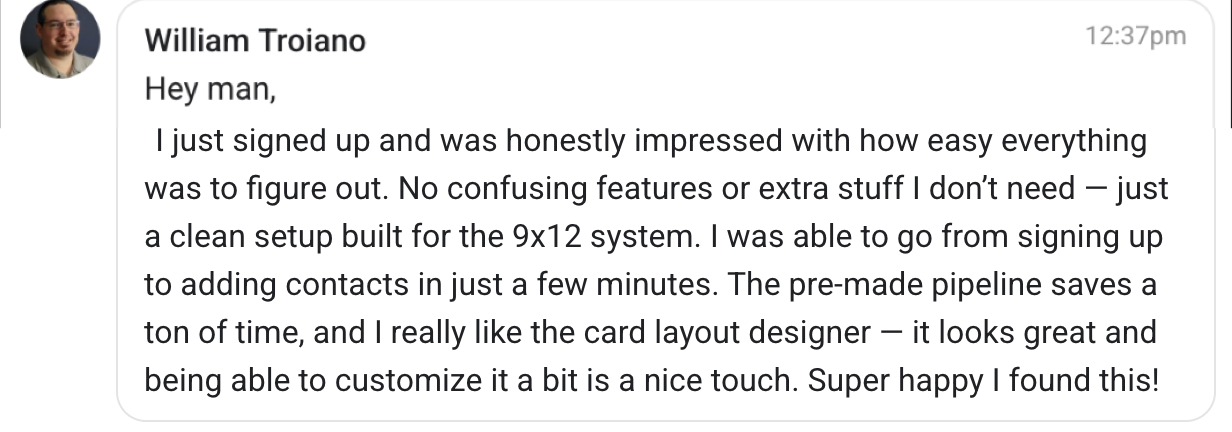
William nailed it. No confusing features. No extra stuff you don't need. Just a clean setup built for the 9x12 system. That's the whole point.
What the 9x12 CRM Actually Does
Let me break it down. Here are the core features and why each one matters for your postcard business.
Pre-Built Sales Pipeline
When you sign up, you don't start from a blank screen. There's already a pipeline waiting for you that mirrors the actual stages of selling ad slots:
- New lead comes in (from outreach, referral, Lead Scout, whatever)
- First contact made — you pitched them or sent the intro
- Follow-up stage — they're interested but haven't committed
- Card mockup sent — they're seeing their ad on the card
- Closed — they paid and they're on the card
No setup required. No YouTube tutorial needed. You sign up, you see the pipeline, you start dragging contacts through it.
Contact Management
You can store every business you've ever talked to — name, phone, email, industry, notes from your conversations. When someone says "Call me back next month," you write that down and the CRM reminds you.
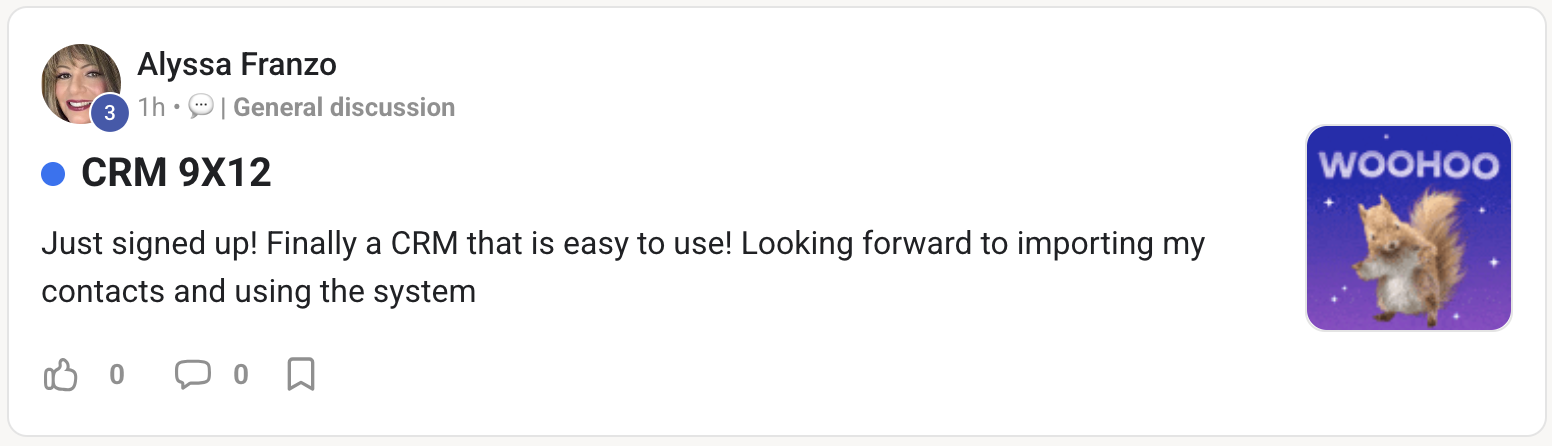
Alyssa's reaction is what I hear from almost everyone. "Finally a CRM that is easy to use." That was the entire design goal. If it's not easy, operators won't use it. And a CRM you don't use is worthless.
Bulk Contact Import
This one's huge. If you've been running your business off a spreadsheet (no judgment — we've all been there), you can import your entire contact list in seconds.
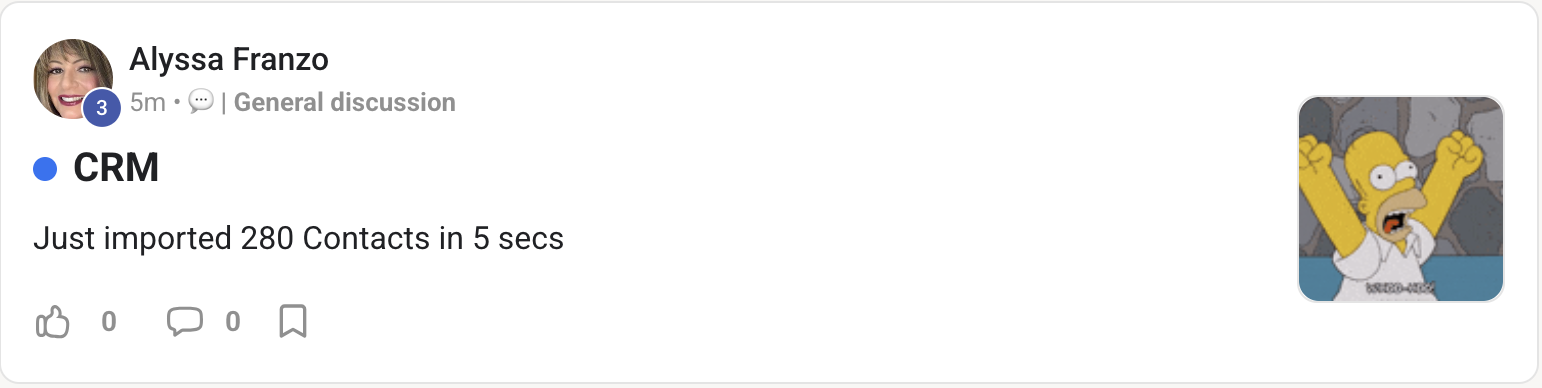
280 contacts in 5 seconds. That's not marketing copy — that's Alyssa's actual experience. You export your spreadsheet, upload the CSV, and boom. All your contacts are in the CRM, ready to be organized.
Card Management and Tracking
This is a feature you will not find in HubSpot. Or Pipedrive. Or any other CRM on the planet.
In the 9x12 business, you need to know which advertisers are on which card, which slots are filled, which ones are open, and who's up for renewal. That's not a "deal" in the traditional CRM sense — it's a completely different data model.
The 9x12 CRM lets you:
- Create and manage individual cards (your "Dover Spotlight," your "York Spotlight," whatever you name them)
- Assign advertisers to specific card slots
- See at a glance how many slots are filled vs. open
- Use the built-in card layout designer to visualize your card
When you can see that you have 12 out of 16 slots filled and only need four more to hit $5,100 in profit — that changes how you approach your week. It's not abstract anymore. It's four more conversations.
Follow-Up Reminders (The Money Feature)
I'm calling this the money feature because it is. Literally.
Here's what happens without follow-up reminders: You talk to a roofer on Tuesday. He says "I'm interested but let me think about it." You think "I'll call him back Friday." Friday comes and you're busy knocking on doors for new leads. The roofer is forgotten. He was ready to buy. Gone.
The CRM lets you set a follow-up reminder on any contact. Date, time, notes about what to say. When that reminder fires, you know exactly who to call and what to talk about.
The second, third, and fourth touch is where deals close. Full stop. A CRM without follow-up reminders is like a calendar without dates — technically it exists, but it's not doing anything for you.
Built-In Invoicing
Here's something I didn't expect to matter as much as it does: invoicing.
When you close a slot, you need to collect $500. Some operators were using Venmo. Some were using PayPal. Some were sending handwritten invoices (seriously). The CRM has invoicing built right in — create an invoice, send it to the advertiser, track whether it's been paid.
No more chasing payments through three different apps. No more "wait, did they pay me for the June card?" It's all in one place.
This matters more when you start scaling. One card with 16 advertisers is manageable. Two or three cards per month? That's 32–48 invoices. You need a system.
Renewal Tracking for Recurring Revenue
This is where the real money is. Most operators focus entirely on filling the first card, and that makes sense — it's the first milestone. But the life-changing money in this business comes from renewals.
Think about it. You already did the hard work. You already sold the roofer on the concept. You already showed them the card. They already saw results. When it's time for the next mailing, renewing that slot should be a five-minute phone call, not a brand-new sales pitch.
The CRM tracks renewal dates for every advertiser on every card. When a renewal is coming up, you see it. You make the call. You lock them in again. That's how operators go from one card to two to three cards per month — not by constantly finding brand-new advertisers, but by keeping the ones they already have.
The business that prints money isn't the one that's always hustling for new clients. It's the one where clients keep coming back.
Full transparency — I teach all of this inside the 9x12 Method community. The renewal playbook, the scripts, the timing. But even without the community, the CRM handles the mechanical side of tracking when renewals are due and who needs a call.
How the CRM Connects with Lead Scout
If you're using Lead Scout to pull leads — business name, email, phone number, social profiles — the workflow is dead simple.
- Go to Lead Scout and pull leads by industry and zip code (example: "dentists in 19701")
- Export those leads
- Import them into the 9x12 CRM
- Start working them through your pipeline — cold email, cold call, door knock
That's how you go from "I don't know who to contact" to "I have 50 warm leads in my CRM" in about ten minutes. The top outreach channels our operators use are Facebook groups, cold email, cold calling, and door-to-door — and all of those work better when you have a list of real businesses with real contact info sitting in your pipeline.
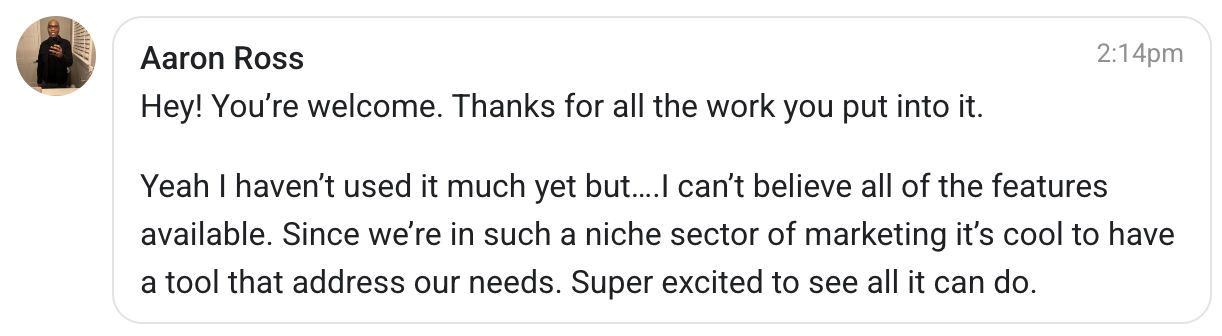
Aaron's point is the one I keep hearing: "Since we're in such a niche sector of marketing it's cool to have a tool that addresses our needs." That's it. That's the whole reason this exists.
When to Start Using the CRM (Hint: Day One)
I hear this one a lot. "I'll set up my CRM once I get a few cards under my belt." "I don't need a CRM yet — I only have a handful of leads."
Wrong.
The best time to start using a CRM for direct mail is before you make your first call. Here's why:
- You build the habit of logging every conversation from day one
- You never lose a lead because it "fell through the cracks"
- When you go from 10 contacts to 100 contacts, everything is already organized
- Your follow-up game is dialed in from the very first prospect
The worst time to set up a CRM is when you already have 200 contacts scattered across sticky notes, text messages, and a spreadsheet with four different tabs. Don't be that person. I've been that person. It's not fun.
It is that simple. Sign up at 9x12methodcrm.com, import whatever contacts you have (even if it's five), and start working your pipeline. You can be up and running in minutes — William said it took him just a few minutes to go from signing up to adding contacts. That's not an exaggeration.
The Real Talk on Whether You Need This
Full transparency. You don't need the 9x12 method CRM to run this business. People have filled cards using Google Sheets. People have filled cards using a notebook and a pen. The math still works either way — 16 slots at $500 is $8,000, minus $2,900 for print and fulfillment through print.9x12method.com, leaves you $5,100 in profit regardless of what software you use.
But here's what I've seen across 2,800+ community members: the operators who track their follow-ups consistently close more slots. The operators who know exactly when a renewal is coming up retain more advertisers. The operators who have a clean pipeline instead of a chaotic spreadsheet scale faster.
The CRM doesn't make you a better salesperson. It just makes sure you don't forget to be one.
If you're serious about running this as a real business — not a side project you tinker with for a month — having a real system matters. And if you're going to use a CRM anyway, you might as well use one that was built for exactly what you're doing.
You can also check out Our Local Spotlight to get your operator pin on the map and build local credibility, which feeds right into your CRM pipeline when prospects start coming inbound.
Frequently Asked Questions
Is the 9x12 Method CRM only for 9x12 operators?
It was built specifically for the 9x12 shared-mail postcard business. The pipeline stages, card management features, and renewal tracking are all designed around this model. Could you technically use it for another business? Maybe. But it's purpose-built for this one, and that's what makes it different from generic CRMs that try to do everything.
Can I import contacts from a spreadsheet into the CRM?
Yes — and it's fast. You export your spreadsheet as a CSV and upload it directly. Alyssa from the community imported 280 contacts in 5 seconds. Whether you're coming from Google Sheets, Excel, or another CRM, you can bring your existing contacts over without manually re-entering anything.
Do I need the CRM if I'm just starting my first card?
Honestly, that's the best time to start. Building the habit of logging every conversation, setting follow-up reminders, and tracking your pipeline from day one means you won't have to untangle a mess later. You don't need 200 contacts to justify using a CRM — even 10 contacts in a clean pipeline beats 10 contacts in your text messages.
How does the 9x12 CRM work with Lead Scout?
You pull leads from Lead Scout by industry and zip code — it gives you business names, emails, phone numbers, and social profiles. Then you export those leads and import them into the CRM. From there, you work them through your pipeline using whatever outreach channel works for you: cold email, cold calling, door-to-door, Facebook groups.
Does the CRM handle invoicing and payments?
Yes. You can create and send invoices directly from the CRM when an advertiser commits to a slot. It tracks payment status so you always know who's paid and who hasn't. This becomes especially important when you're running multiple cards and managing 30–50 advertiser relationships at once.
What makes this different from HubSpot or Pipedrive?
Those are great CRMs — for SaaS companies, agencies, and e-commerce brands. They weren't built for a postcard business. You won't find card management, slot tracking, card layout designers, or renewal workflows in any generic CRM. The 9x12 CRM skips the 47 features you don't need and focuses entirely on the workflow that actually matters for filling and managing shared-mail cards.
As always, I'm rooting for you.
Ready to start your 9x12 business?
Join the 9x12 Method community for scripts, templates, coaching calls, and a group that celebrates every win — even your first one.
Course + community included · Cancel anytime · Full transparency: you don't need this to start
More from the blog
Free vs Paid Direct Mail Software: Hidden Costs
Everybody loves free. Free CRM. Free lead finder. Free landing page builder. Free email tool. You Google "free direct mail software" and you get a page full of…
9x12 Sites: Build Your Business Website Fast
Most operators overthink their web presence. They spend weeks picking WordPress themes, fighting with plugins, trying to make their "About Us" page sound…
Lead Scout: Find Business Contacts Fast
If you've ever spent an entire afternoon Googling "plumbers near me," clicking through 40 websites, and copy-pasting emails into a spreadsheet one by one — you…