
Free vs Paid Direct Mail Software: Hidden Costs
Free direct mail software sounds great until you see the hidden costs. Here's what free tools actually cost you in time, data, and missed revenue.

Everybody loves free. Free CRM. Free lead finder. Free landing page builder. Free email tool. You Google "free direct mail software" and you get a page full of options that promise you can run your entire business without spending a dime on tools.
And technically, they're right. You can.
But here's the thing — nobody ever tells you what "free" actually costs. Not in dollars. In time. In lost deals. In features you'll outgrow in two weeks. In the 45 minutes you spend every morning wrestling with a spreadsheet instead of actually selling slots.
I've watched hundreds of operators go through this cycle inside our community. They start with free everything. Three months later, they're paying for tools anyway — but they've already lost a month of revenue to the friction they were trying to avoid paying to remove. So let's talk about the hidden costs nobody warns you about.
The spreadsheet trap
This is where almost everyone starts. Google Sheets. Maybe Notion. Maybe a notebook. You write down the business name, the owner's name, their email, and whether they said yes, no, or "let me think about it."
For your first 10 contacts, this works fine. For your first 20, it's annoying. By the time you have 60 prospects across two cards — some warm, some cold, some who said "call me next month" — your spreadsheet is a disaster. You're scrolling through rows trying to remember who you were supposed to follow up with yesterday. You can't sort by status. You can't set reminders. You just hope you remember.
| What happens | The real cost |
|---|---|
| Forgot to follow up with a warm lead | $500 lost (one slot) |
| Lost track of 3 "call me next month" leads | $1,500 lost |
| Can't tell which card a prospect is assigned to | Confusion, double-selling |
| No invoicing — chasing payments manually | Hours per week |
| No renewal tracking | Repeat customers fall through cracks |
Here's the math that nobody does. A purpose-built CRM costs you a small monthly fee. Losing track of three warm leads because your spreadsheet doesn't have follow-up reminders costs you $1,500 in actual revenue. The "free" option is more expensive. It just doesn't feel like it because the loss is invisible.
Free CRMs — what they don't tell you
Okay, so you graduate from the spreadsheet. You sign up for a free CRM. Smart move, right?
Sort of. Here's what most free CRMs actually look like when you try to use them for a postcard business:
- 47 features you don't need — pipeline stages designed for SaaS sales, deal forecasting, marketing automation, lead scoring algorithms. You sell ad slots on postcards. You need "contacted," "interested," "sold," and "follow up Tuesday."
- Zero features you do need — no card management (which advertisers are on which card?), no slot tracking (which slots are filled, which are open?), no EDDM-specific workflow, no renewal tracking for recurring advertisers.
- Contact limits — most free tiers cap you at 250-500 contacts. That sounds like a lot until you realize you need 50-100 contacts per card to close 16 slots. By card #3 you're hitting the wall.
- The upsell treadmill — the free tier exists to get you hooked. Then it's $29/month for the features you actually need. Then $49/month. Then $79/month for the "team" plan. By the time you're paying for what you actually use, you're spending more than a purpose-built tool would cost.
The dirty secret of free software is that the business model depends on you eventually paying. The free tier is the sales funnel. Every limitation is designed to create just enough pain that you upgrade. And when you do upgrade, you're paying for a general-purpose tool that still doesn't understand your business.
The beauty of this is that you don't need a CRM that does everything. You need a CRM that does one thing — run a postcard business. The simpler the tool, the faster you move.
Free lead finders — the time tax
Same pattern with lead generation tools. You can absolutely find local business contacts for free. Here's the "free" workflow:
- Open Google Maps. Search "HVAC companies near Dover, NH."
- Click the first result. Look for an email address. Check the header, footer, contact page.
- Can't find an email? Click their Facebook link. Check the About page.
- Copy the email into your spreadsheet. Add the phone number. Add the owner's name if you can find it.
- Repeat 50-100 times per card.
That workflow takes 3-5 hours per card. Every single time. And the data quality is inconsistent — half the emails bounce, some of the phone numbers are old, and you're missing social profiles entirely.
Now multiply that by 2-3 cards a month. You're spending 6-15 hours a month just finding contact info. At $5,100 profit per card, your time is worth roughly $170/hour when you're selling. Spending 5 hours on data entry instead of outreach is costing you the equivalent of $850 in productive time.
Free doesn't mean efficient. And in a business where your profit per card is fixed at $5,100, every hour you waste on administrative work is an hour you're not spending on the only thing that actually generates revenue: talking to business owners.
Free landing pages — the credibility problem
You can build a free website. Tons of platforms offer free tiers. But here's what a free landing page actually looks like from your prospect's perspective:
- A generic template that looks like every other free site
- The platform's branding in the footer ("Made with [Platform Name]")
- A subdomain like
yourname.freebuilder.cominstead of a real URL - No postcard-specific features — no card preview, no slot availability, no target map
- No built-in analytics — you have no idea if anyone visited, how long they stayed, or whether they clicked anything
When you're asking a business owner to hand you $500, the website they land on either builds trust or kills it. A free page with someone else's branding and a generic template sends a message: "This person isn't serious enough to invest in their own business." That's not the message you want to send.
Compare that to a purpose-built landing page designed for postcard operators — one that shows your live card preview with available slots, your target map with demographic data, advertiser testimonials, and a contact form that captures leads directly into your pipeline. The prospect isn't looking at a template. They're looking at a professional operation.
Free QR tracking — what you're actually measuring
Some operators slap a free QR code on their postcard and call it tracking. But free QR generators typically give you one thing: a total scan count. That's it.
You can't see when the scans happened. You can't see where they happened. You can't see which ads got the most engagement. And when your advertiser asks "how do I know my ad is working?" — your answer is "well, the whole card got some scans." That's not a renewal pitch. That's a guess.
Real scan tracking — the kind that logs each scan with timestamp, location, and device — gives you ammunition for the renewal conversation. "Your ad got 47 scans this month, mostly on weekday evenings, clustered in the 03820 zip code." That's data. That closes renewals. Free QR tools don't give you that.
The real comparison — free stack vs purpose-built stack
Let me put the full picture side by side.
| Category | Free stack | Purpose-built |
|---|---|---|
| CRM | Spreadsheet or generic free tier | Built for postcard sales workflow |
| Lead generation | Manual Google Maps research | Automated by industry + area |
| Landing page | Generic template with platform branding | Card preview, target map, lead capture |
| QR tracking | Total scan count only | Per-ad tracking with timestamps |
| Ad design | DIY in Canva from scratch | AI-generated print-ready ads |
| Credibility | None — you're a stranger | Partner directory with 300+ operators |
| Time cost per card | 8-15 extra hours | Minutes |
| Revenue risk | High (lost follow-ups, weak pitch) | Low (systematic, tracked) |
The free stack works. I want to be clear about that. You can run this entire business with Google Sheets, Google Maps, a free website, and a free QR generator. People have done it. People will continue to do it.
But the question isn't "can I?" — it's "should I?" When one lost follow-up costs you $500 and a purpose-built CRM costs a fraction of that, the math answers itself.
The credibility stack nobody talks about
Here's a hidden cost that's harder to quantify but might be the most expensive one: the credibility gap.
When you're brand new, you have zero proof. No past cards. No testimonials. No network. A business owner Googles you and finds nothing. That kills deals. Not because your pitch was bad — because the prospect couldn't verify that you're real.
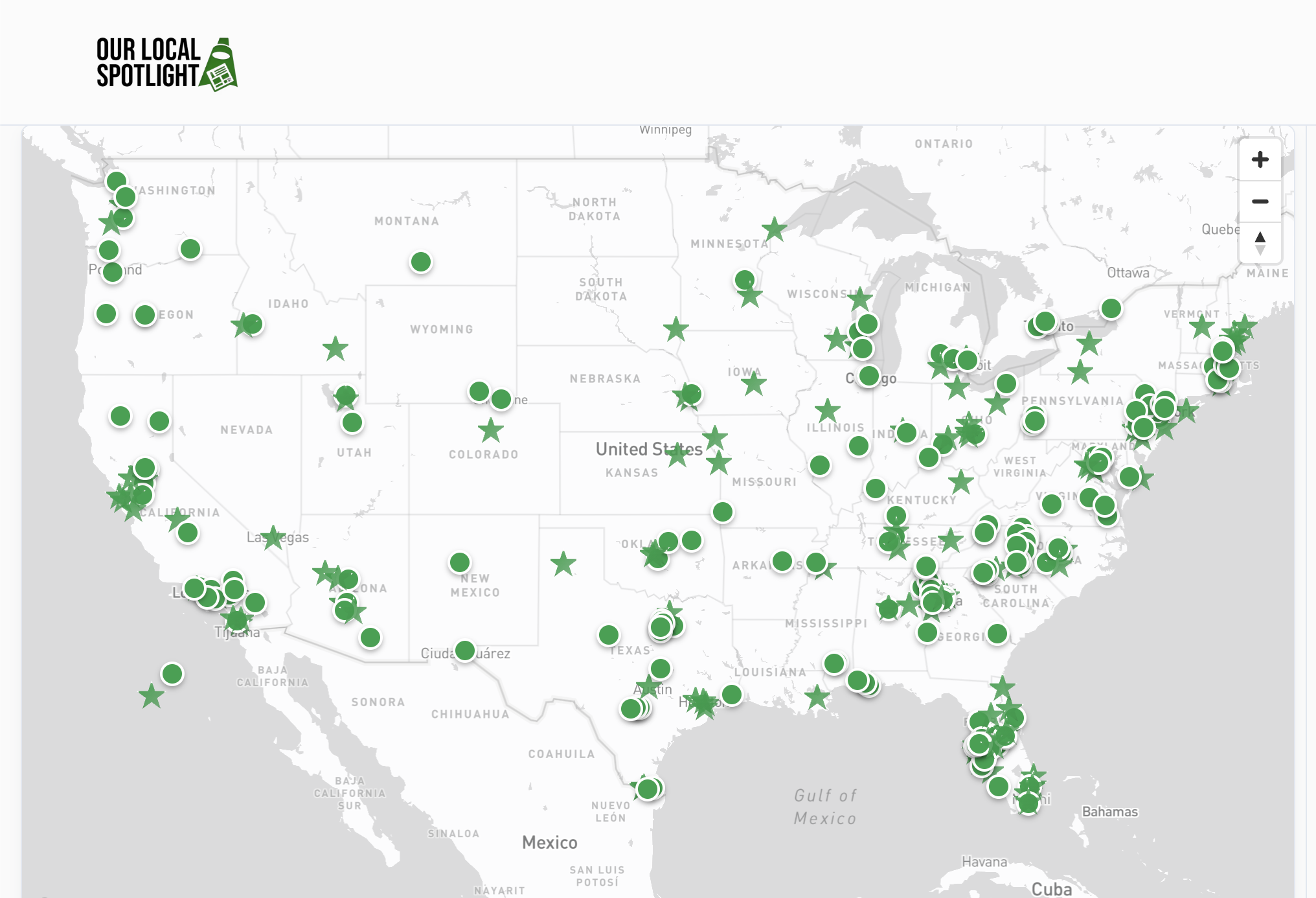
That's the Our Local Spotlight partner directory. 300+ verified operators on the map. When you're listed there, you're not just some random person sending cold emails — you're a verified partner in a national network. The free pin costs nothing. The full landing page with your photo, past cards, and testimonials is $33/month — and it earns you exclusivity on that location. You own your spot on the map for as long as you're a partner. Nobody else can claim your territory.
No free tool gives you that. No amount of DIY website building puts you inside a network of 300+ operators that a prospect can browse and verify. That third-party credibility is something you simply can't replicate for free.
When free makes sense (and when it doesn't)
I'm not going to tell you free tools are always bad. That would be dishonest. Here's my actual take:
Free makes sense when:
- You're validating the business model before committing any money
- You're selling your first card and want to minimize risk
- You're testing a new market and don't know if it'll work
- You genuinely can't afford $30-50/month yet
Free stops making sense when:
- You've sold your first card and know the model works
- You're losing track of follow-ups and can feel the missed revenue
- You're spending more time on admin than selling
- You're running 2+ cards and the spreadsheet is breaking down
- You're pitching businesses and have zero online credibility
The transition point is usually somewhere around card #1 or #2. By the time you've proven the model and you're scaling to multiple cards, the time tax of free tools is eating into your profit more than the cost of purpose-built tools ever would.
The tools I'd recommend (and yes, I'm biased)
Full transparency — I built tools specifically for this business. I obviously think they're the best option. But I'm going to tell you exactly why, and you can decide for yourself.
- 9x12 Method CRM — pre-built pipeline for the postcard sales cycle, card management, invoicing, follow-up reminders, renewal tracking. No features you don't need. All the features you do.
- Lead Scout — pulls local business contacts by industry and area. Name, email, phone, social profiles. 15,000 lookups, works out to about 2 cents per lead. Minutes instead of hours.
- Our Local Spotlight — free pin on the partner directory. $33/month for a full landing page with location exclusivity. 300+ operators on the map backing your credibility.
- AI Ad Designer at ads.9x12method.com — generates print-ready postcard ads. Free for community members.
- ScanLab — per-ad QR tracking with timestamps and location data. Free for community members.
Every single one is optional. You can run this business with zero tools. But the operators who scale fastest — the ones doing 2-3 cards a month and clearing $10K+ — almost all use purpose-built tools because they've done the math on their own time.
The "free" path costs you 8-15 hours per card in administrative overhead. At $5,100 profit per card, those hours are worth more than any tool subscription.
Simple math. Simple decision.
As always, I'm rooting for you.
Frequently Asked Questions
Can I really run a direct mail business with only free tools?
Yes. You can use Google Sheets for tracking, Google Maps for finding leads, a free website builder for your landing page, and a free QR generator for tracking. People do it successfully. The tradeoff is time — you'll spend significantly more hours on administrative work per card, and you'll miss some deals due to lost follow-ups and weaker credibility. But the business model itself works regardless of what tools you use.
What's the biggest hidden cost of free direct mail software?
Lost follow-ups. This is the one that costs operators the most money without them realizing it. When you're tracking 60+ prospects across multiple cards in a spreadsheet, leads slip through the cracks. Most sales close on the 2nd, 3rd, or 4th touch. If you forget to follow up with just three warm leads per card, that's $1,500 in potential revenue gone — far more than any CRM subscription would cost.
How much time does free software actually cost per card?
Based on what operators in our community report, the free stack adds roughly 8-15 hours of administrative overhead per card compared to purpose-built tools. That includes manual lead research (3-5 hours), spreadsheet management (2-3 hours), invoice chasing (1-2 hours), and dealing with various free tool limitations. At 2-3 cards per month, that's 16-45 hours of your time.
When should I switch from free tools to paid tools?
Most operators hit the inflection point after their first card. Once you've proven the model works and you're starting card #2, the time cost of free tools starts eating into your profit margin noticeably. The switch usually pays for itself within the first month because you close more deals through better follow-up tracking and faster lead generation.
Are purpose-built postcard tools worth more than generic business tools?
In most cases, yes. A generic CRM at $49-79/month gives you hundreds of features designed for SaaS sales, real estate, or e-commerce — none of which apply to selling postcard ad slots. A purpose-built CRM costs less and includes the exact workflow you need: advertiser pipeline, card management, slot tracking, invoicing, and renewal reminders. You're paying less for more relevant functionality.
What free tools should I keep even after upgrading to paid ones?
Canva's free tier is genuinely useful for ad design even if you have other tools. Google Maps is still great for local market research and route planning. And the free pin on Our Local Spotlight costs nothing and gives you directory presence immediately. The tools worth paying for are the ones that save you significant time (lead generation, CRM) or directly help you close more deals (landing pages, QR tracking, credibility platforms).
Ready to start your 9x12 business?
Join the 9x12 Method community for scripts, templates, coaching calls, and a group that celebrates every win — even your first one.
Course + community included · Cancel anytime · Full transparency: you don't need this to start
More from the blog
9x12 Sites: Build Your Business Website Fast
Most operators overthink their web presence. They spend weeks picking WordPress themes, fighting with plugins, trying to make their "About Us" page sound…
Lead Scout: Find Business Contacts Fast
If you've ever spent an entire afternoon Googling "plumbers near me," clicking through 40 websites, and copy-pasting emails into a spreadsheet one by one — you…
9x12 Method CRM: The Complete Guide
Most operators who struggle with this business aren't struggling because of sales. They're struggling because they forgot to follow up. They had the warm lead…