
Lead Scout: Find Business Contacts Fast
Lead Scout pulls local business contacts by industry and area in seconds. See how 9x12 operators use it to build lead lists and fill postcard slots faster.

If you've ever spent an entire afternoon Googling "plumbers near me," clicking through 40 websites, and copy-pasting emails into a spreadsheet one by one — you already know the pain. That slow, manual grind is the single biggest reason new operators stall out before they ever fill their first card. Lead Scout at leads.9x12method.com exists because I got tired of watching people waste hours on something a tool should handle in minutes.
Here's the thing. Finding local business leads shouldn't be the hard part of this business. Selling the slot, designing the card, building relationships — that's where your energy should go. Not sitting there like a data entry clerk copying phone numbers from Google Maps into a spreadsheet at 11pm on a Tuesday.
The Old Way of Finding Local Business Leads
Let me paint the picture because I know you've lived it. Or you're about to.
You pick a town. Let's say you're going after HVAC companies in your area. So you open Google, type "HVAC companies near me," and start clicking. First result — you land on their website. You scroll around looking for an email address. Sometimes it's on the contact page. Sometimes it's buried in the footer. Sometimes it doesn't exist at all and there's just a contact form.
You find one email. You copy it. You paste it into your spreadsheet. You go back to Google. Click the next result. Repeat.
After an hour, you've got maybe 12 leads. And half of those emails are generic "info@" addresses that nobody checks.
That's a full workday just to build one list for one industry in one town. And you haven't even started outreach yet. You haven't sent a single email. You haven't made a single call. You've just been... copying and pasting.
The Google Maps Method (Better, But Still Brutal)
Some operators figured out a smarter approach. Instead of Googling, you go straight to Google Maps, search for an industry in a specific area, and work through the listings. Google Maps gives you the business name, phone number, address, and sometimes a website link.
This is genuinely better. The data is more accurate because Google Maps pulls from verified business listings. You're seeing real businesses that actually operate in that area. And you can visually scan a map to make sure you're hitting the right zip codes for your EDDM routes.
But here's why it still sucks: you still have to click into each business, visit their website, hunt for the email, check for social profiles, and manually record everything. The accuracy is great. The speed is terrible.
Lead Scout automates the entire Google Maps approach. That's literally what it does. It runs the same search you'd run manually — industry plus area — then visits each business website, pulls the email address, phone number, and social media profiles, and hands you a clean list. The stuff that took you 4–8 hours now takes about 15 minutes.
How Lead Scout Actually Works
I'm going to walk you through it because it's embarrassingly simple. No learning curve. No 47-minute tutorial video. No certification.
- Go to leads.9x12method.com and log in.
- Pick your town or area. Type in the city, zip code, or region you want to target.
- Pick your industry. Roofers, HVAC, painters, landscapers, dentists, chiropractors — whatever you're going after.
- Hit search. Lead Scout goes out, finds the businesses, visits their websites, and pulls the contact data.
- Download your list. You get names, emails, phone numbers, and social profiles — ready to drop into your CRM and start outreach.
It is that simple. Five steps. No filtering through garbage data. No deduplication. No "is this email even real?" guessing games.
What the Community Is Saying
Full transparency — I built Lead Scout because our operators kept asking for it. But I don't need to sell you on it. The people actually using it are doing a better job of that than I ever could.
David Rogers did a detailed comparison between Lead Scout and D7 Lead Finder, which is one of the more well-known lead tools out there. His findings were pretty telling — with D7, he was filtering out 90–95% of the results because they weren't relevant. Lead Scout, because it automates the Google Maps approach specifically, gave him targeted results from the jump. He pulled a list of 20 plumbers and got 6 direct email addresses, compared to D7's data which he called "incorrect." One-time purchase versus $55/month. Less than 2 cents per lead.
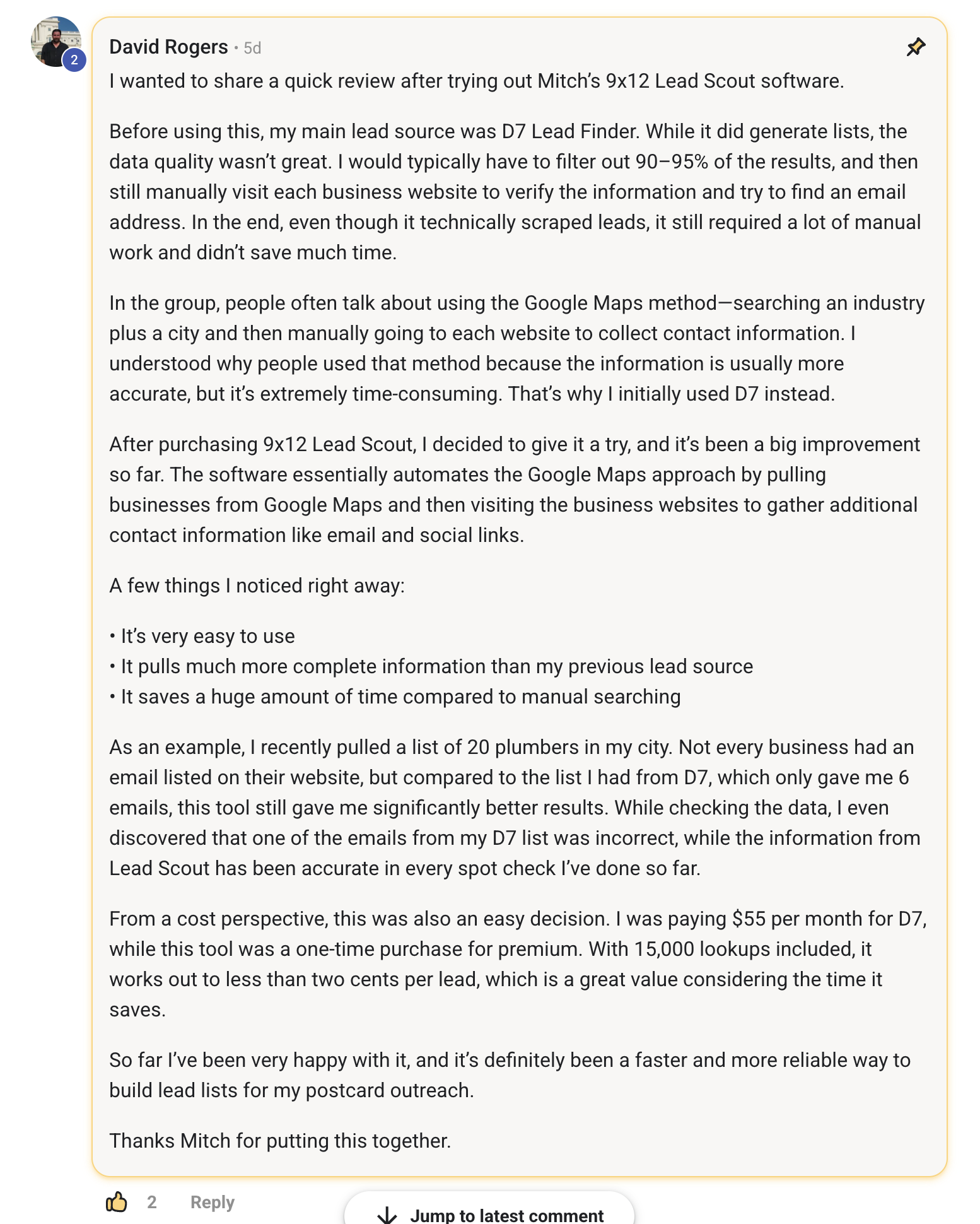
And David's not alone. Here's what other operators are saying after actually using it.
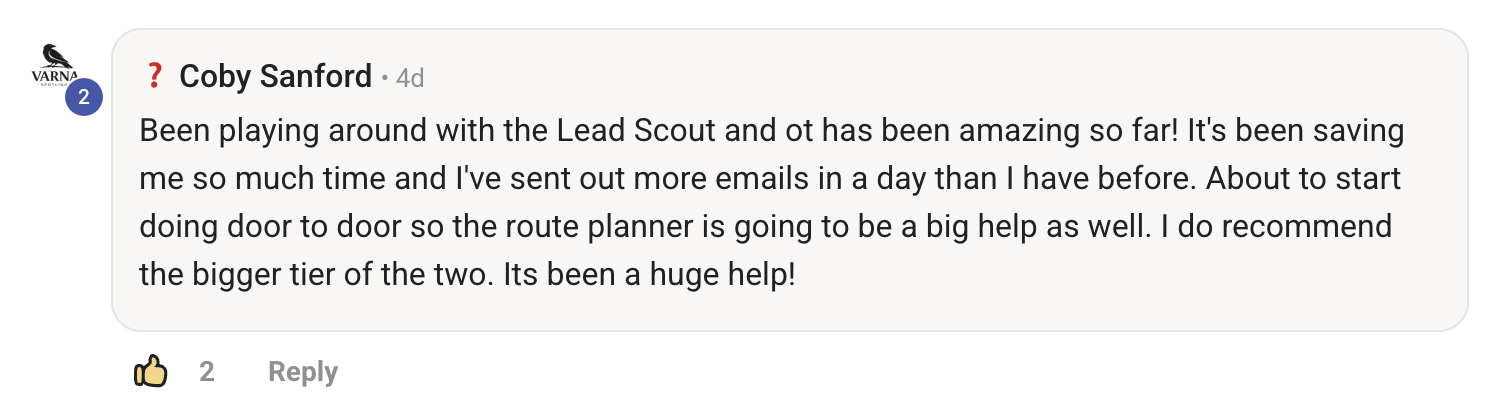
Coby Sanford said it's been saving him so much time that he's sent out more emails in a single day than he ever had before. That's the whole point. The tool doesn't close deals for you — it just removes the bottleneck so you can actually do the work that closes deals.
The Numbers Behind Lead Scout
Let's talk about what you're actually getting. Because I know you're wondering.
Fifteen thousand lookups. At roughly 2 cents per lead, that's an absurd amount of prospecting power. And it's a one-time purchase — not a monthly subscription bleeding you dry while you're trying to get your first card filled.
Compare that to D7 Lead Finder at $55/month. Even if D7 worked perfectly (which, according to David's testing, it doesn't for this use case), you're paying $660/year for something that still requires heavy manual filtering.
The tools should make you faster, not make you broke. A one-time purchase that gives you 15,000 lookups is how it should work.
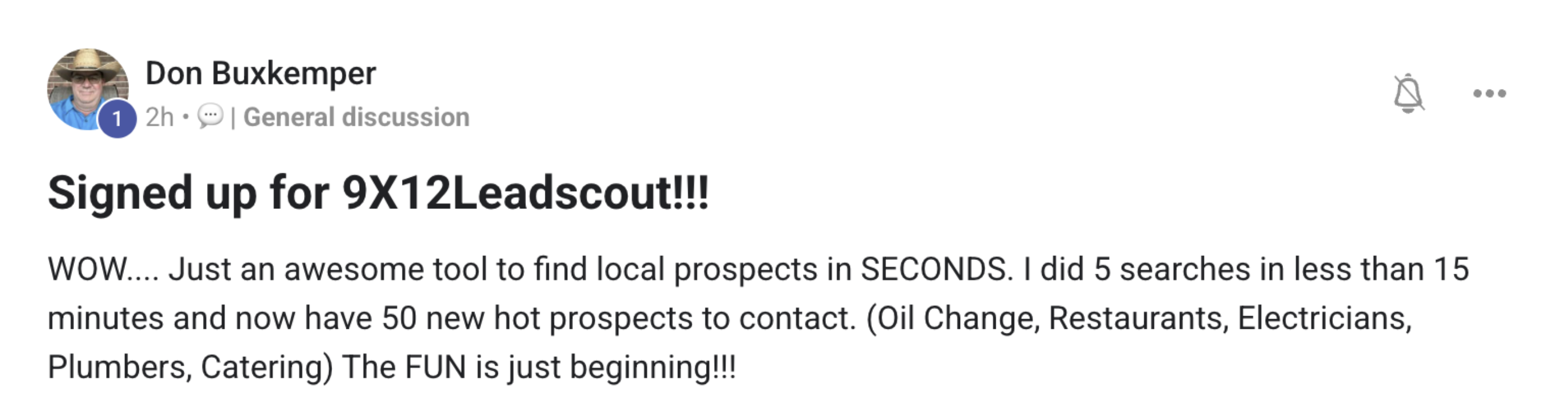
Don Buxkemper put it perfectly. He did 5 searches in less than 15 minutes and walked away with 50 new prospects across oil change shops, restaurants, electricians, plumbers, and catering companies. That's the kind of speed that changes your day.
Best Industries to Target With Lead Scout
Not all industries are created equal when it comes to postcard marketing. Some businesses immediately get it — they understand local advertising, they have the budget, and they're used to paying for marketing. Others need more convincing.
Here are the industries our 2,800+ community members consistently close the fastest:
- Roofers — always advertising, always need leads, seasonal urgency
- HVAC companies — same energy, huge seasonal swings drive ad spend
- Painters — local-only businesses that live and die by word of mouth
- Landscapers — spring and summer are goldmines for these guys
- Dentists — always looking for new patients, understand marketing spend
- Chiropractors — similar to dentists, always need new patients
- Window cleaners — highly local, low competition for their attention
- Car dealerships / car washes — community-focused, love local exposure
- Realtors — always farming neighborhoods, perfect fit for EDDM zones
The key is to search multiple industries in the same area. You need about 50–100 contacts to close 16 slots. It's a numbers game. Not every business will say yes. Not every email will get a reply. But if you're reaching out to 100 businesses, you only need 16 to say yes. That's a 16% close rate, which is very doable with the scripts and frameworks inside the community.
Route Mapping for Door-to-Door Operators
Here's something that sets Lead Scout apart from every other lead tool I've seen. There's a route mapping feature built in for operators who do door-to-door prospecting.
Look — cold email is great. Cold calling works. Facebook groups are still the number one outreach channel for our operators. But some people just prefer walking into a business, shaking a hand, and having a conversation. And honestly? The close rate on in-person visits is insane compared to digital outreach.
Ryan Hook called this out specifically.
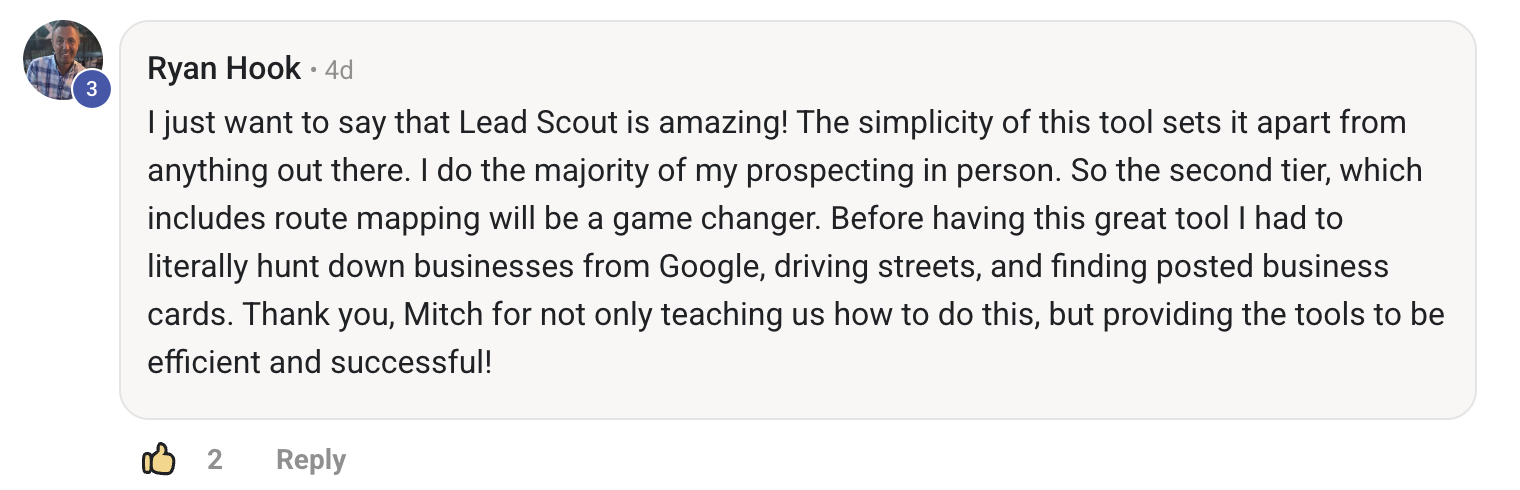
Ryan does the majority of his prospecting in person. The route mapping feature lets him plan his visits efficiently — hit 10–15 businesses in a single afternoon instead of driving around aimlessly hoping to spot a good prospect. That's the difference between productive prospecting and just... driving around.
Lead Scout + CRM: The Full Pipeline
Here's where it all clicks together. Lead Scout gives you the contacts. The 9x12 Method CRM gives you the system to work those contacts into paying advertisers.
The workflow looks like this:
- Run your Lead Scout searches — pull 50–100 contacts across multiple industries in your target area.
- Export the list and import it into your CRM.
- Set up your outreach sequences — cold email, follow-up reminders, call tasks.
- Work the pipeline daily. Send your emails. Make your calls. Track who replied, who's interested, who said "not right now."
- Close 16 slots. Collect $8,000. Print the card for $2,900. Pocket $5,100.
That's the whole system. Lead Scout fills the top of the funnel. The CRM manages the middle. Your outreach skills close the bottom. Every piece has a job.
Full transparency — I do teach the entire outreach system inside the community. Scripts, templates, email sequences, objection handling, all of it. But you don't need the community to use Lead Scout. You don't need the CRM either. You could pull your leads, paste them into a Google Sheet, and start emailing from Gmail. It would work. The tools just make it faster and more organized.
Overdelivery Is Built In
One thing I want to mention because it keeps happening. Sherron Finney ordered 300 leads and got back over 700. That's not a glitch — that's how the tool works. When Lead Scout searches an area, it pulls everything it finds. If there are more businesses than you expected, you get more contacts than you paid for.
Aaron John put it in perspective.
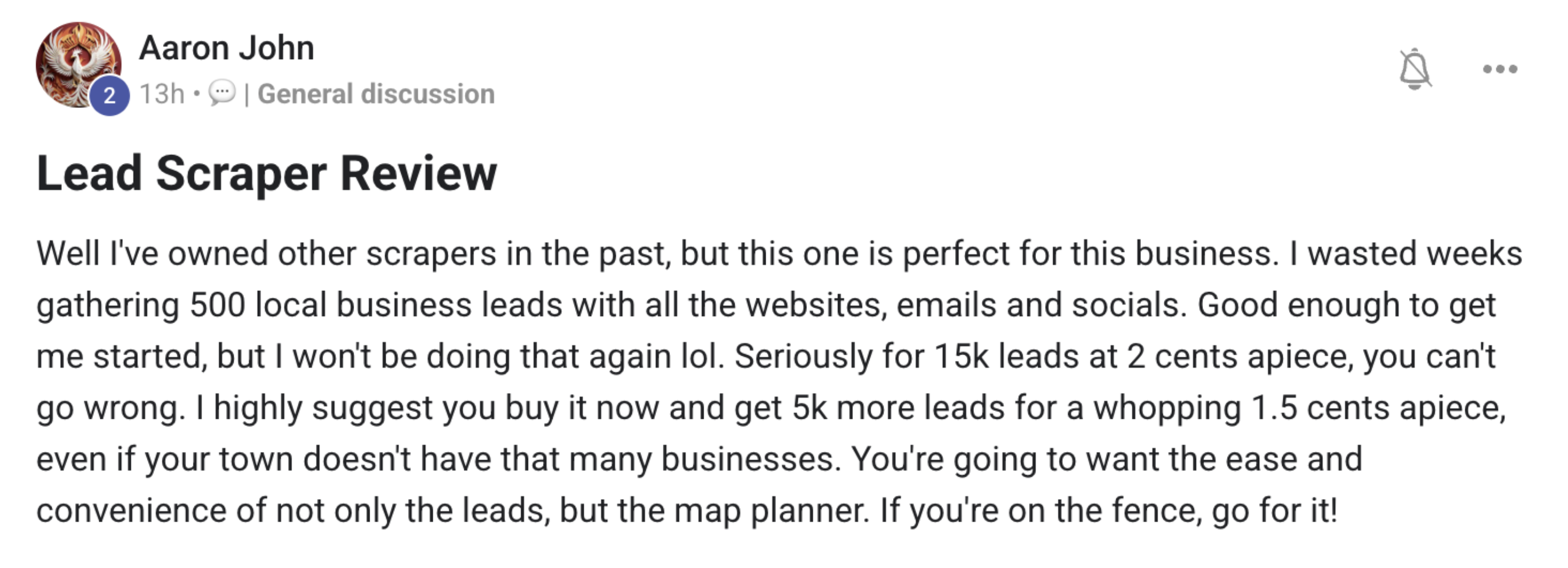
Aaron had owned other scrapers before. He'd wasted weeks manually gathering 500 local business leads. With Lead Scout, he got 15,000 lookups at 2 cents each. His exact words: "you can't go wrong." And honestly? He's right. When you compare the time cost of manually building lists versus spending a couple bucks on a tool that does it in minutes — it's not even a decision.
Why This Matters for Your First Card
Okay so let me bring this home. Because if you're reading this, you're probably in one of two spots:
Spot 1: You haven't started yet. You're researching the 9x12 method, figuring out if it's real, and trying to understand what the actual day-to-day looks like. If that's you — the biggest thing holding most new operators back is the prospecting phase. They know they need to reach out to businesses. They just don't know which businesses, or how to find their contact info quickly. Lead Scout solves that completely.
Spot 2: You've started but you're stuck. You sent out 10–15 emails and got crickets. You're wondering if the model even works. Here's the thing — 10–15 emails isn't enough. It's a numbers game. You need to be reaching out to 50–100 businesses to close 16 slots. If you've been manually building your lists, you probably burned out before you ever hit real volume. That's a list-building problem, not a business model problem.
Either way, the answer is the same: build a bigger list, faster, and spend your time on outreach instead of data entry. That's it. That's what Lead Scout does.
How to Get Started With Lead Scout Today
If you want to try it, here's the play:
- Head to leads.9x12method.com.
- Pick one town and three industries. Start with roofers, HVAC, and painters — they're the easiest first sells.
- Pull your lists. You should have 30–60 contacts in under 10 minutes.
- Drop those contacts into your CRM or a simple spreadsheet.
- Start outreach today. Not tomorrow. Today. Send 20 emails. Make 10 calls. Post in 3 Facebook groups.
That's it. No overthinking. No "I need to research more before I start." You have the leads. Now go talk to people.
The top outreach channels our operators use, in order: Facebook groups (number one by far), cold email, cold calling, door-to-door, Facebook Live, and DMs. Pick two. Work them daily. You'll have a full card before you know it.
And if you want the full system — scripts, email templates, weekly coaching calls, 2,800+ operators sharing what's working right now — the community at skool.com/9x12method is where all of that lives. Full transparency — it's a paid community. You absolutely do not need it to get started. But if you're serious about building this into a real business, it'll save you months of figuring things out on your own.
As always, I'm rooting for you. Go build that list and fill that card.
Frequently Asked Questions
What is Lead Scout and how does it work?
Lead Scout is a prospecting tool at leads.9x12method.com that automates the process of finding local business contact information. You pick an industry and an area, and it searches Google Maps listings, visits business websites, and pulls back names, email addresses, phone numbers, and social media profiles. It's built specifically for 9x12 postcard operators who need to find business contacts fast without spending hours on manual research.
How many leads do I need to fill a 9x12 postcard?
You need about 50–100 contacts to close 16 advertising slots on a single card. Not every business will respond to your outreach, and not every response will turn into a sale. At a 16% close rate — which is realistic with good scripts and follow-up — 100 contacts gets you 16 paying advertisers at $500 each. That's $8,000 in revenue and $5,100 in profit after print and fulfillment costs.
How does Lead Scout compare to D7 Lead Finder?
Community member David Rogers tested both head-to-head. With D7 Lead Finder ($55/month), he found himself filtering out 90–95% of results because they weren't relevant to his area or industry. D7 also returned incorrect contact data. Lead Scout, because it automates the Google Maps search method, returned targeted, accurate results. He pulled 20 plumbers and got 6 verified email addresses. Lead Scout is also a one-time purchase versus D7's recurring monthly fee.
What industries should I search for first?
Start with roofers, HVAC companies, and painters. These three industries consistently close the fastest because they already understand local advertising, they have marketing budgets, and they need a steady flow of new customers. After those, branch into landscapers, dentists, chiropractors, and window cleaners. The community has detailed breakdowns of which industries convert best by region.
Can I use Lead Scout without the 9x12 Method CRM?
Yes. Lead Scout is a standalone tool. You can export your contact lists and use them however you want — in a Google Sheet, a different CRM, or even just a notebook if that's your style. That said, the 9x12 Method CRM is built specifically for this business model, so it handles things like outreach tracking, follow-up sequences, and pipeline management in a way that generic tools don't. But it's not required.
Does Lead Scout work for door-to-door prospecting?
Absolutely. Lead Scout includes a route mapping feature that lets you plan in-person visits efficiently. Instead of driving around town hoping to spot good prospects, you can map out a list of businesses by location, plan your route, and hit 10–15 stops in a single afternoon. Several operators in the community — like Ryan Hook — do the majority of their prospecting in person and use Lead Scout's route mapping as their primary planning tool.
Ready to start your 9x12 business?
Join the 9x12 Method community for scripts, templates, coaching calls, and a group that celebrates every win — even your first one.
Course + community included · Cancel anytime · Full transparency: you don't need this to start
More from the blog
Free vs Paid Direct Mail Software: Hidden Costs
Everybody loves free. Free CRM. Free lead finder. Free landing page builder. Free email tool. You Google "free direct mail software" and you get a page full of…
9x12 Sites: Build Your Business Website Fast
Most operators overthink their web presence. They spend weeks picking WordPress themes, fighting with plugins, trying to make their "About Us" page sound…
9x12 Method CRM: The Complete Guide
Most operators who struggle with this business aren't struggling because of sales. They're struggling because they forgot to follow up. They had the warm lead…